
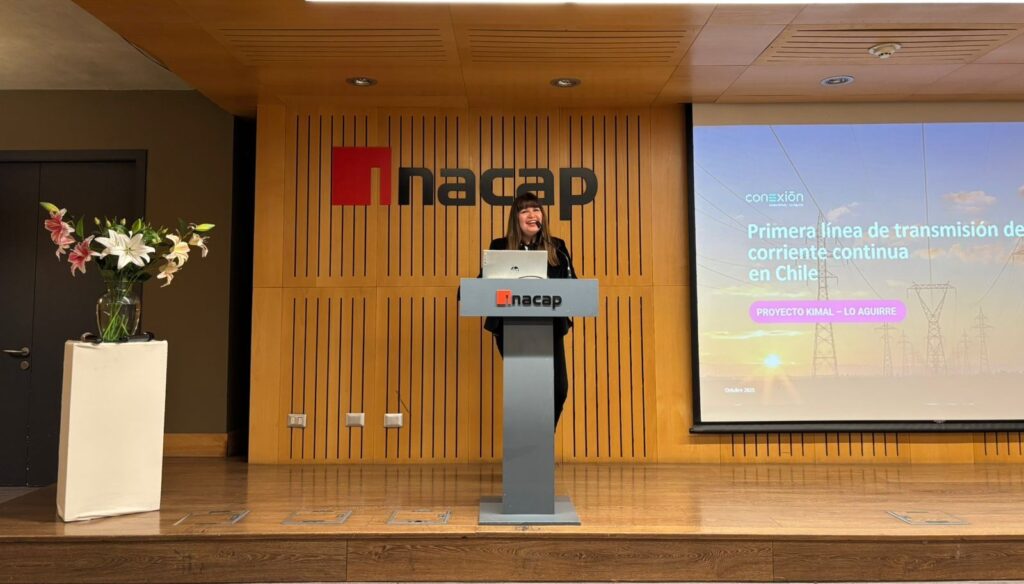
As part of its program of partnerships with higher education institutions and technical training centers, the Kimal–Lo Aguirre HVDC transmission project participated in a talk held at Inacap’s Santiago Centro headquarters, aimed at students and professionals in the energy sector. The event aimed to bring the experience of real electrical infrastructure projects closer to the educational process, emphasizing responsible energy and environmental commitment.
The activity was led by Johana Villar, Head of Environmental Assessment for the Kimal-Lo Aguirre Connection, who shared her professional experience in the development of the line, addressing the importance of integrating environmental criteria from the initial stages of design, evaluation, and execution of electrical transmission projects.
During her presentation, Villar stressed that the energy transition requires not only new technologies, but also technicians and professionals trained to understand the environmental impact of projects and contribute to their responsible management. “The energy that powers Chile must be built with environmental responsibility and with professionals who are aware of the impact that technical decisions have on the environment. These types of talks motivate new generations to take on this challenge with knowledge and conviction,” she said.
For her part, Viviana Ávalos, Academic Director of Energy and Sustainability at Inacap, highlighted this meeting with students as a way to connect them with real-life experiences in an industry as strategic for Chile as the electricity sector. “It enriches the educational process of our students and reaffirms our work linked to the productive sectors to train relevant technical and professional talent that responds to today’s demands and regulations. The energy transition not only needs new technologies, but also people prepared to understand the environmental impact of each project and manage it responsibly,” she said.
The meeting provided an opportunity to reflect on the role that technical training plays today in the development of energy projects that are increasingly demanding in environmental and regulatory terms. It also brought students closer to the challenges facing the sector.