

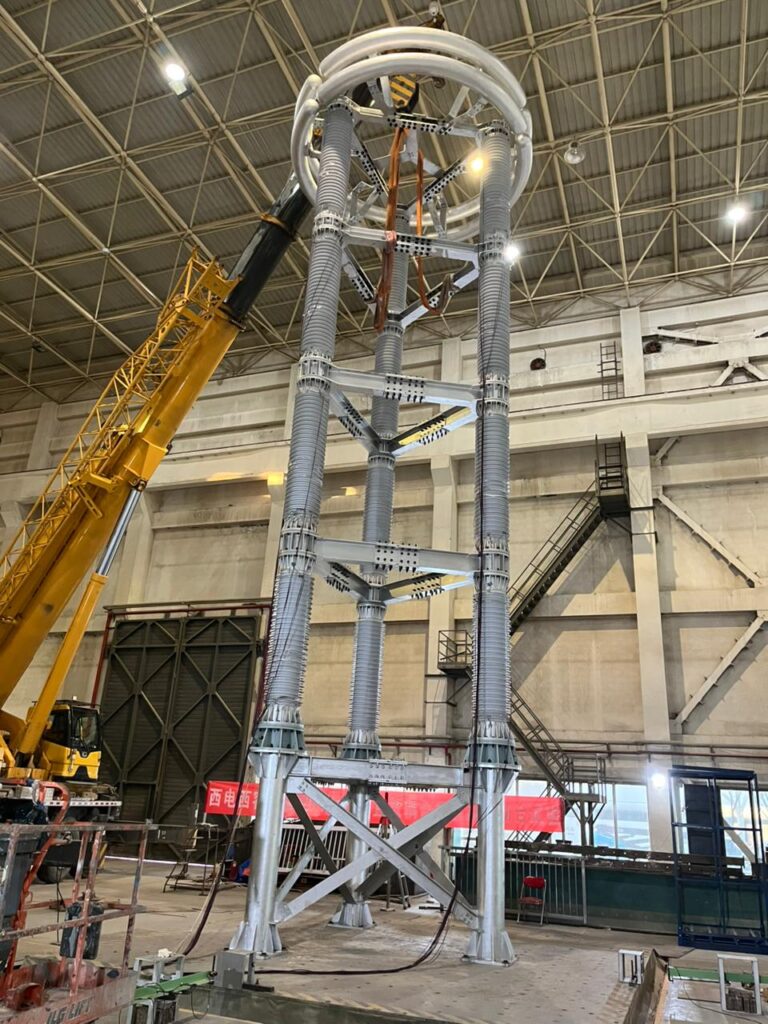
The measure aims to ensure the resilience and availability of critical infrastructure.
The Kimal-Lo Aguirre project is currently conducting a series of tests on critical equipment intended for future converter substations, with the goal of verifying its ability to withstand severe earthquakes without compromising its functionality.
The tests, conducted in accordance with national and international standards, include vibration table tests on both alternating current (AC) and direct current (DC) equipment. The latter is part of a technology that will be installed for the first time in Chile. Testing began in late 2025 at laboratories in Beijing, China, and to date, four tests have been conducted with satisfactory results. The program includes the execution of 12 additional tests, including an upcoming test scheduled for late May 2026.
Among the equipment already tested are a 500 kV current transformer, an 855.2 kV type C surge arrester, a 600 kV voltage measuring device, and a 600 kV coupling capacitor.
Key Validation
Shake table tests are one of the most rigorous methods of seismic qualification for electrical equipment. Unlike theoretical analyses or computer simulations, these tests reproduce on a full scale the accelerations and displacements that equipment would experience during a major earthquake, allowing for the evaluation of its structural and functional behavior during and after the event.
“In a country like Chile, where critical infrastructure must operate under extreme seismic conditions, this type of validation is key to ensuring operational continuity, facility safety, and the reliability of the electrical system,” Conexión notes.
In the case of the Kimal-Lo Aguirre project, the complexity is even greater due to the incorporation of HVDC technology. Direct current transmission involves equipment of great height, mass, and structural complexity, which is particularly sensitive to seismic forces. Equipment such as the 600 kV coupling capacitor and the Type C lightning arrester also feature structural configurations unprecedented in Chile, which has required the development of specific solutions to ensure their proper performance under the seismic conditions typical of Chilean territory.
“The larger and heavier the equipment, the more complex its response to a seismic event becomes. Beyond regulatory compliance, the project has incorporated design optimization processes and innovative solutions aimed at improving the seismic performance of the equipment, including seismic isolation systems and damping devices, which help reduce the stresses to which they are exposed during an earthquake,” explained the project’s technical team.
The equipment has been evaluated for two seismic performance levels—Design Level and Performance Level—in accordance with the criteria established in the international standard IEEE 693-2018. This allows for verification of both the equipment’s resistance to severe earthquakes and the maintenance of its functionality following the event, a fundamental aspect for ensuring the resilience and availability of critical infrastructure such as that associated with the Kimal-Lo Aguirre project.