

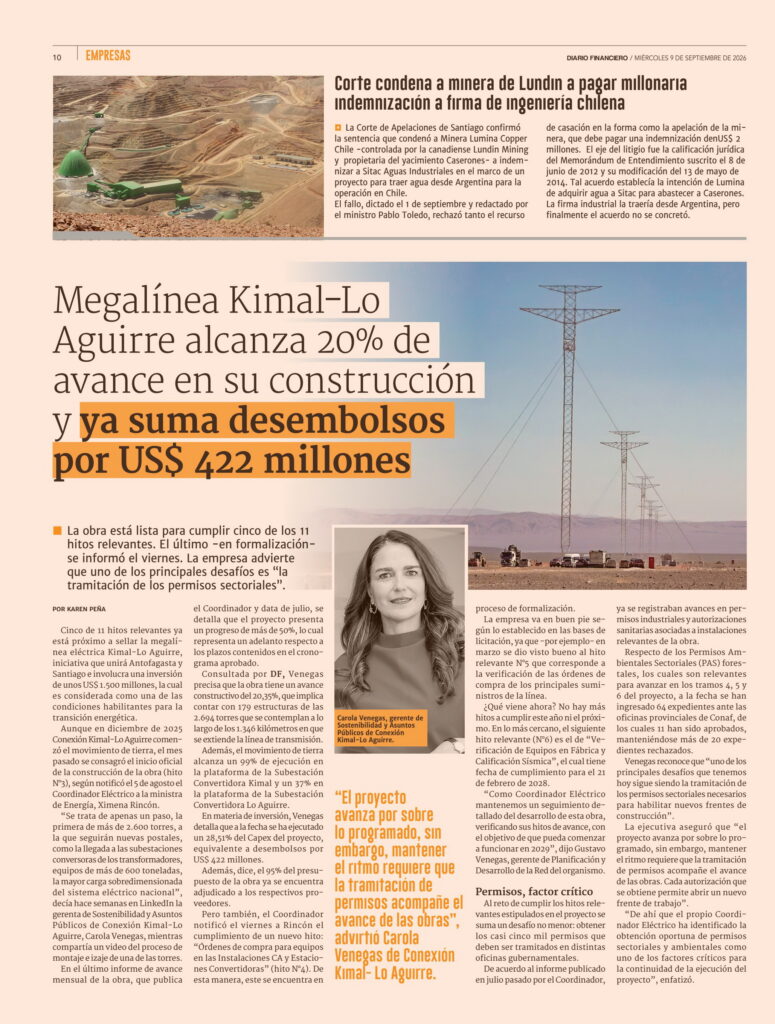
The project is on track to meet five of the 11 key milestones. The latest milestone—which is in the process of being formalized—was announced on Friday. The company notes that one of the main challenges is “obtaining sector-specific permits.”
The Kimal-Lo Aguirre mega-power line—a project that will connect Antofagasta and Santiago and involves an investment of approximately US$1.5 billion—is now close to achieving five of its 11 key milestones; this initiative is considered one of the enabling conditions for the energy transition.
Although Conexión Kimal-Lo Aguirre began earthwork in December 2025, last month marked the official start of construction (milestone No. 3), as the Electricity Coordinator notified Energy Minister Ximena Rincón on August 5.
“This is just one step—the first of more than 2,600 towers—to be followed by new milestones, such as the arrival of the transformers at the converter substations, equipment weighing more than 600 metric tons, the largest oversized load in the national power system,” wrote Carola Venegas, Sustainability and Public Affairs Manager at Conexión Kimal-Lo Aguirre, on LinkedIn a few weeks ago, while sharing a video of the assembly and hoisting process for one of the towers.
The latest monthly progress report on the project, published by the Project Coordinator and dated July, details that the project is more than 50% complete, which represents progress ahead of the deadlines set in the approved schedule.
When asked by DF, Venegas clarified that construction progress stands at 20.35%, meaning that 179 of the 2,694 towers planned along the 1,346-kilometer transmission line have been erected.
In addition, earthwork is 99% complete at the Kimal Converter Substation site and 37% complete at the Lo Aguirre Converter Substation site.
Regarding investment, Venegas explains that to date, 28.51% of the project’s Capex has been spent, equivalent to disbursements totaling US$422 million.
Furthermore, he says, 95% of the project budget has already been awarded to the respective suppliers.
The Coordinator also notified Rincón on Friday of the achievement of a new milestone: “Purchase orders for equipment at the CA Facilities and Converter Stations” (milestone No. 4). This milestone is currently in the process of being formalized.
The company is on track according to the terms of the bid, since—for example—in March, approval was granted for the relevant milestone No. 5, which corresponds to the verification of purchase orders for the line’s main supplies.
What’s next? There are no further milestones to meet this year or next. In the near term, the next relevant milestone (No. 6) is “Factory Equipment Verification and Seismic Qualification,” with a completion date of February 21, 2028.
“As the Electrical Coordinator, we are closely monitoring the progress of this project, verifying its milestones, with the goal of having it operational by 2029,” said Gustavo Venegas, the agency’s Network Planning and Development Manager.
Permits: A Critical Factor
In addition to the challenge of meeting the key milestones stipulated in the project, there is another significant hurdle: obtaining the nearly 5,000 permits that must be processed through various government agencies.
According to a report published last July by the Coordinator, progress had already been made on industrial permits and health authorizations associated with key project facilities.
Regarding the forestry Sectoral Environmental Permits (PAS)—which are essential for moving forward with project sections 4, 5, and 6—64 applications have been submitted to the provincial offices of CONAF to date, of which 11 have been approved, while more than 20 remain rejected.
Venegas acknowledges that “one of the main challenges we face today continues to be the processing of the sectoral permits necessary to open new construction fronts.”
The executive stated that “the project is progressing ahead of schedule; however, maintaining this pace requires that the permit process keep pace with the progress of the construction work. Each authorization obtained allows us to open a new work front.”
“That is why the Electricity Coordinator himself has identified the timely acquisition of sector-specific and environmental permits as one of the critical factors for the continued execution of the project,” she emphasized.