

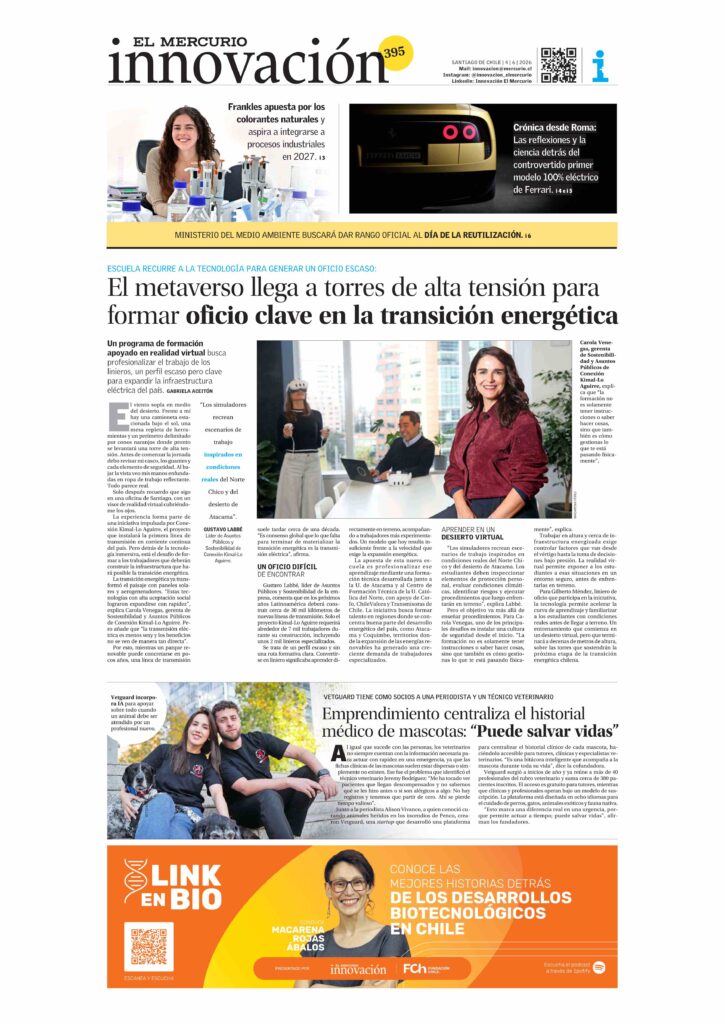
A virtual reality-based training program aims to professionalize the work of linemen, a scarce but critical workforce for expanding the country’s electrical infrastructure.
The wind blows across the desert. In front of me is a pickup truck parked in the sun, a table piled high with tools, and an area marked off by orange cones where a high-voltage tower will soon be erected. Before starting the day, I must check my helmet, gloves, and every safety item. Looking down, I see my hands encased in reflective workwear. Everything seems real.
Only then do I remember that I’m still in an office in Santiago, with a virtual reality headset covering my eyes.
The experience is part of an initiative led by Conexión Kimal-Lo Aguirre, the project that will install the country’s first direct current transmission line. But behind the immersive technology lies the challenge of training the workers who will build the infrastructure that will make the energy transition possible.
The energy transition has already transformed the landscape with solar panels and wind turbines. “These technologies, which enjoy high public acceptance, managed to expand rapidly,” explains Carola Venegas, Sustainability and Public Affairs Manager at Conexión Kimal-Lo Aguirre. But she adds that “electricity transmission is less sexy, and the benefits aren’t as immediately apparent.”
For this reason, while a renewable energy park can be completed in a few years, a transmission line typically takes about a decade. ‘There is a global consensus that what is missing to fully realize the energy transition is electricity transmission,’ she states.
A Hard-to-Find Trade
Gustavo Labbé, the company’s Head of Public Affairs and Sustainability, notes that in the coming years, Latin America will need to build nearly 30,000 kilometers of new transmission lines. The Kimal-Lo Aguirre project alone will require around 7,000 workers during construction, including some 2,000 specialized linemen.
This is a scarce skill set with no clear training path. Becoming a lineman used to mean learning directly on the job, working alongside more experienced workers. A model that is now insufficient given the speed required by energy expansion.
This new school aims to professionalize this learning through technical training developed in partnership with the University of Atacama and the Technical Training Center of the Catholic University of the North, with support from Corfo, ChileValora, and Transmisoras de Chile. The initiative aims to train talent in regions where much of the country’s energy development is concentrated, such as Atacama and Coquimbo—areas where the expansion of renewable energy has generated a growing demand for specialized workers.
Learning in a Virtual Desert
“The simulators recreate work scenarios inspired by real-world conditions in the Norte Chico region and the Atacama Desert. Students must inspect personal protective equipment, assess weather conditions, identify risks, and execute procedures they will later encounter in the field,” explains Labbé.
But the goal goes beyond teaching procedures. For Carola Venegas, one of the main challenges is instilling a culture of safety from the very beginning. ‘Training isn’t just about following instructions or knowing how to do things; it’s also about how you manage what’s happening to you physically,’ she explains.
Working at heights and near live power lines requires managing factors ranging from vertigo to decision-making under pressure. Virtual reality allows students to be exposed to these situations in a safe environment before facing them in the field.
For Gilberto Méndez, a line worker participating in the initiative, the technology accelerates the learning curve and familiarizes students with real-world conditions before they head out into the field. It’s training that begins in a virtual desert but will end dozens of meters up, atop the towers that will support the next phase of Chile’s energy transition.