

ECONOMY. This initiative, which aims to strengthen the national power grid and make it more reliable, will create more than 6,900 direct jobs at the peak of construction.
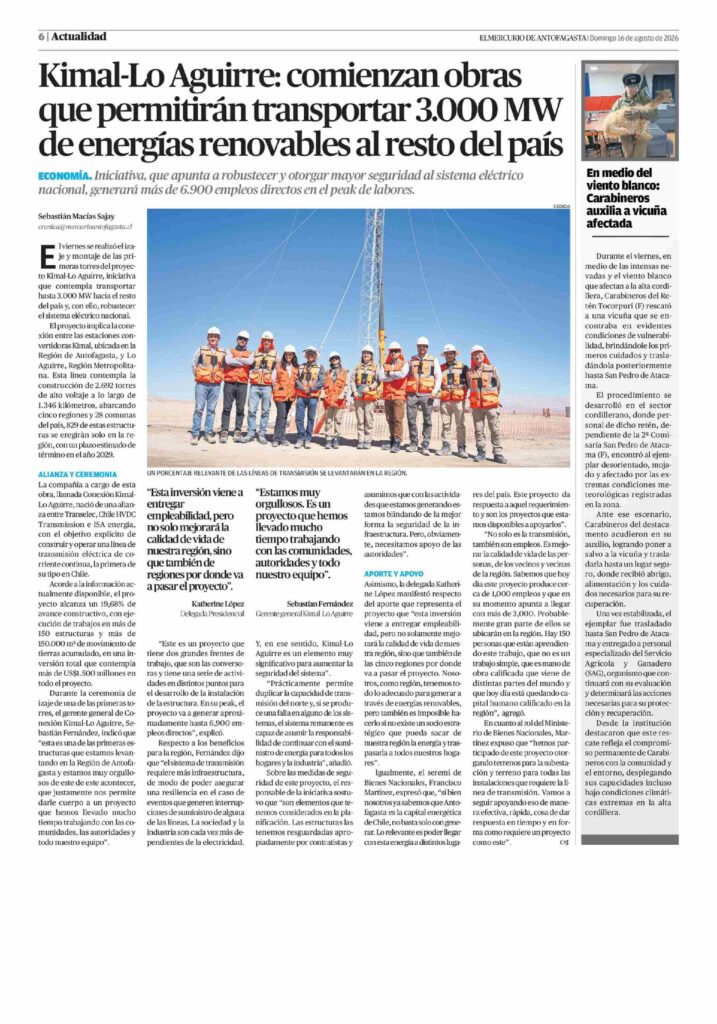
On Friday, the first towers for the Kimal-Lo Aguirre project were hoisted and assembled. This initiative is designed to transmit up to 3,000 MW to the rest of the country, thereby strengthening the national power grid.
The project involves connecting the Kimal converter station, located in the Antofagasta Region, with the Lo Aguirre converter station in the Metropolitan Region. This transmission line involves the construction of 2,692 high-voltage towers along 1,346 kilometers, spanning five regions and 28 municipalities across the country; 829 of these structures will be erected in the region alone, with an estimated completion date in 2029.
Partnership and Ceremony
The company in charge of this project, known as the Kimal-Lo Aguirre Connection, was formed through a partnership between Transelec, Chile HVDC Transmission, and ISA Energía, with the explicit goal of building and operating a high-voltage direct current (HVDC) transmission line—the first of its kind in Chile.
According to currently available information, the project is 19.68% complete, with work underway on more than 150 structures and over 150,000 m³ of cumulative earthwork, representing a total investment of more than US$1.5 billion for the entire project.
During the hoisting ceremony for one of the first towers, Sebastián Fernández, general manager of Conexión Kimal-Lo Aguirre, stated that “this is one of the first structures we are erecting in the Antofagasta Region, and we are very proud of this milestone, which allows us to bring to life a project we have been working on for a long time with the communities, the authorities, and our entire team.”
“This is a project with two major work fronts—the converter stations—and involves a series of activities at various locations for the construction of the infrastructure. At its peak, the project will generate approximately 6,900 direct jobs,” he explained.
Regarding the benefits for the region, Fernández said that “the transmission system requires more infrastructure to ensure resilience in the event of incidents that cause supply interruptions on any of the lines. Society and industry are increasingly dependent on electricity. And, in that sense, Kimal-Lo Aguirre is a very significant element in enhancing the system’s reliability.”
“It effectively doubles the transmission capacity in the north, and if a failure occurs in any of the systems, the remaining system is capable of taking over and continuing to supply power to all households and industry,” he added.
Regarding the safety measures for this project, the project leader stated that “these are factors we have taken into account in our planning. The structures are being properly secured by contractors, and we believe that through the activities we are carrying out, we are ensuring the infrastructure’s safety in the best possible way. But, obviously, we need support from the authorities.”
Contribution and Support
Likewise, Delegate Katherine López stated regarding the project’s contribution that “this investment will create job opportunities, but it will not only improve the quality of life in our region but also in the five regions through which the project will pass. “We, as a region, have everything we need to generate energy through renewable sources, but it is impossible to do so without a strategic partner capable of transporting the energy from our region to all our homes.”
Similarly, the Regional Minister for National Assets, Francisco Martínez, stated that, “while we already know that Antofagasta is Chile’s energy capital, simply generating power is not enough. What matters is being able to deliver this energy to different parts of the country. This project addresses that need, and these are the kinds of projects we are ready to support.”
“It’s not just about transmission; it’s also about jobs. It’s about improving the quality of life for people—for the residents of the region. We know that today this project creates nearly 1,000 jobs and that, in time, it aims to create more than 3,000. A large portion of those jobs will likely be located in the region. There are 150 people learning this trade—which is not a simple job—skilled workers from different parts of the world, and today, qualified human capital is being retained in the region,” he added.
Regarding the role of the Ministry of National Assets, Martínez explained that “we have participated in this project by providing land for the substation and land for all the facilities required by the transmission line. We will continue to support this effort effectively and promptly, ensuring a timely and appropriate response as required by a project like this.”
“This investment will create jobs, but it will not only improve the quality of life in our region but also in the regions through which the project will pass.” – Katherine López, Presidential Delegate
“We are very proud. This is a project we have been working on for a long time with the communities, authorities, and our entire team.” – Sebastián Fernández, General Manager of Kimal Lo Aguirre